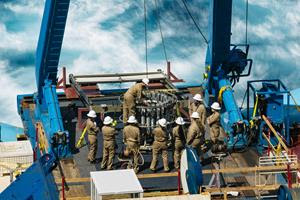
- As part of their regulatory obligations, TMC subsidiaries NORI and TOML have submitted extensive datasets to the International Seabed Authority’s DeepData, covering a decade of exploration in the Clarion Clipperton Zone of the Pacific Ocean
- The dataset includes 777 equipment deployments and over 4,800 distinct environmental samples, generating 76,000 biological records and 69,185 geochemical data points—across the entire water column
- This data builds on two previous submissions (March 2023 and May 2024) comprising hundreds of thousands of biological records, record sampling of pelagic communities below 4,000 meters, and more than 12,000 seafloor images—part of one of the most comprehensive deep-ocean environmental monitoring programs ever undertaken
- Key findings are showcased in a new video series demonstrating how the data addresses environmental concerns and how innovation has reduced the impact footprint of TMC’s collection system versus legacy technology
- Data from NORI and TOML’s $250 million environmental program—already underpinning 37 peer-reviewed publications—reflects the most comprehensive environmental dataset ever assembled for deep-sea minerals development
NEW YORK, April 16, 2026 (GLOBE NEWSWIRE) -- TMC the metals company Inc. (Nasdaq: TMC) (“TMC” or the “Company”), a leading developer of the world’s largest resource of critical metals essential to energy, defense, manufacturing and infrastructure, today announced that its subsidiaries, Nauru Ocean Resources Inc. (NORI) and Tonga Offshore Mining Ltd. (TOML), have submitted comprehensive data from almost a decade of deep-sea exploration to DeepData, an open database of contractor data managed by the International Seabed Authority (ISA).
The submission—spanning 2013-2022 and comprising an unparalleled collection of biological and geochemical samples from across the eastern Clarion Clipperton Zone (CCZ)—builds on a decade of research by NORI and TOML to characterize the polymetallic nodule resource and surrounding marine environment, from the ocean surface through the water column to abyssal sediments more than 4,000 meters deep. The data will be made publicly available through open repositories including DeepData and UNESCO’s Ocean Biodiversity Information System (OBIS) as part of the Company’s commitment to advancing scientific understanding of the deep ocean. With this submission, TMC’s subsidiaries have contributed roughly one-third of all CCZ data in DeepData. The data will also be published to the OBIS-ISA node, where TMC subsidiary data already account for 54% of all biological records—a share expected to increase significantly following publication of this batch. TMC’s dataset is generating significant interest among researchers, with the full OBIS dataset downloaded almost ten thousand times to date and individual taxa downloads totaling more than half a billion.
TMC Environmental Manager, Dr. Michael Clarke, commented: “After more than a decade of research, 27 expeditions, rigorously monitored pilot mining tests, tens of thousands of biological records, and hundreds of thousands of seafloor images, we’ve built one of the most comprehensive deep-sea environmental datasets ever assembled. Backed by over $250 million in investment, our findings don’t stand in isolation—they corroborate decades of prior research, including NOAA’s DOMES program,” he said, referring to the U.S. National Oceanic and Atmospheric Administration’s Deep Ocean Mining Environmental Study program conducted in the 1970s.
With the extensive Environmental Impact Assessment now complete, the Company has begun sharing key takeaways from this comprehensive body of work through a series of videos documenting how its data addresses environmental concerns and how innovation has reduced the impact footprint of its collection system compared to legacy technology.
Environmental Concerns – What Does The Data Tell Us?
Innovation At Depth
- Make it float
- Collect nodules, not mud: The Coanda effect
- Smarter separation at the source
- Midwater release: Less up, less down
- Calming the current
- Go with the flow: Mine planning to reduce impact
Data from NORI and TOML’s offshore campaigns have supported 37 peer-reviewed publications by independent scientists from leading marine research institutions, all of whom retain full freedom to publish. Recent papers include those demonstrating that both biodiversity and sediment plume impacts are confined to the directly mined area. With more than a petabyte of data collected, the Company expects this body of work to expand significantly in the coming years. To date, nearly 200,000 scientific papers have been published on polymetallic nodules globally, including more than 50,000 focused on the eastern CCZ.
Dr. Clarke added: “Activists often repeat the refrain that ‘we don’t know enough’—but that narrative doesn’t hold up against the evidence. The Environmental Impact Assessments produced for the CCZ are, in aggregate, the most extensive ever conducted for any mining project anywhere in the world. That record demands recognition — and it demands that the bar for ‘enough’ be set not by the absence of all uncertainty, but by the presence of sufficient knowledge to manage risk responsibly, with adaptive mechanisms firmly in place. As with any resource project, the science is not perfect, and we will continue to learn and adapt after production begins. But it is, by any reasonable measure, more than sufficient to begin monitored commercial operations. The conclusion has been consistent for more than 50 years: with the right safeguards and monitoring, the environmental impacts of nodule collection can be effectively managed.”
In January, TMC announced that it had submitted the first ever consolidated application under NOAA’s modernized regulatory framework, a permitting pathway that is anticipated to reduce permitting timelines and is available to applicants with sufficient environmental and technical knowledge. NOAA later confirmed substantial compliance of this application on March 9, and the Company expects the final granting of the commercial recovery permit within the next 12 months.
About The Metals Company
The Metals Company is a developer of lower-impact critical metals from seafloor polymetallic nodules, on a dual mission: (1) supply metals for energy, defense, manufacturing and infrastructure with net positive impacts compared to conventional production routes and (2) trace, recover and recycle the metals we supply to help create a metal commons that can be used in perpetuity. The Company has conducted more than a decade of research into the environmental and social impacts of offshore nodule collection and onshore processing. More information is available at www.metals.co.