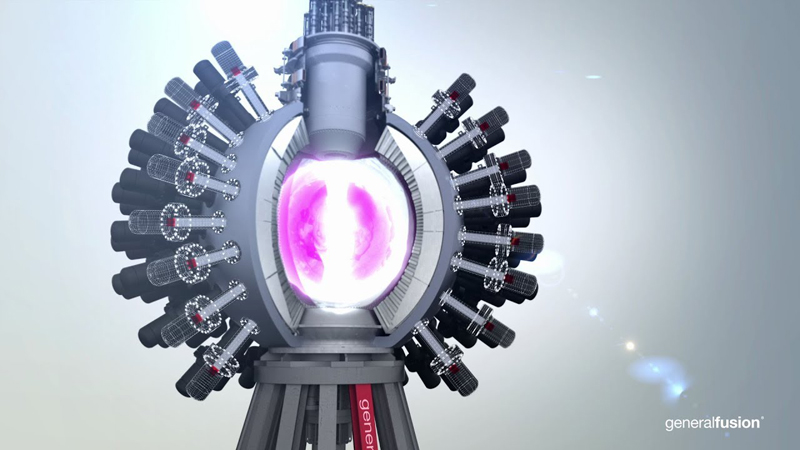
Peer-reviewed research by General Fusion and Savannah River National Laboratory supports the tritium supply advantages of General Fusion’s practical Magnetized Target Fusion technology
VANCOUVER, British Columbia, May 04, 2026 (GLOBE NEWSWIRE) -- General Fusion Inc. (“General Fusion” or the “Company”), a leader in the global race to commercialize fusion energy, announced today that third-party analysis conducted by Savannah River National Laboratory (“SRNL”), supporting the Company’s approach to fusion fuel sustainability, has been published in the peer-reviewed scientific journal Fusion Science and Technology. General Fusion previously announced its plans to go public through a business combination (the transactions contemplated by the business combination, collectively, the “Proposed Business Combination”) with Spring Valley Acquisition Corp. III (NASDAQ: SVAC) (“SVAC”).
The SRNL study, which was completed under the U.S. Department of Energy’s INFUSE program and is available on the Office of Scientific and Technical Information website, evaluated key parameters of General Fusion’s Magnetized Target Fusion (“MTF”) approach and assessed the fuel cycle enabled by the Company’s liquid metal wall technology, which inherently addresses major challenges in fusion power plant design. The liquid metal wall, which is proprietary to General Fusion’s MTF design, shields the fusion machine from neutron activation, produces tritium fuel through neutron interactions with lithium, and efficiently captures the energy produced by fusion.
The researchers at SRNL, according to their publication in Fusion Science and Technology, examined the tritium fuel required to start up and operate a General Fusion power plant, as well as the doubling time needed to breed enough tritium to fuel a second plant. When compared with publicly available data for traditional fusion approaches, such as tokamaks and stellarators, the SRNL study found that General Fusion’s MTF commercial design:
- requires less tritium for the start-up of a commercial fusion power plant;
- achieves a significantly shorter doubling time—the amount of time needed to breed enough tritium to fuel a second power plant; and
- indicates an MTF power plant will produce enough tritium to ensure a self-sustaining fuel source based on the higher tritium breeding ratio.
“This study, where it was important for us to collaborate with Savannah River National Laboratory, one of the leading labs in fuel cycle R&D, demonstrates the many advantages of our MTF with a liquid metal wall,” said Mike Donaldson, Senior Vice President of Technology Development at General Fusion. “The liquid metal wall allows us to own the fuel cycle and provide start-up fuel for a broad fleet of General Fusion power plants.”
“Partnering with companies like General Fusion—who utilized Savannah River National Laboratory's world-leading fuel cycle research, expertise and support—contribute to advancing fusion energy from concept to deployment,” said Associate Laboratory Director Roderick Jackson, who leads the Science, Energy and Innovation Directorate at SRNL. “This collaborative work is bringing us closer to delivering reliable fusion power at commercial scale.”
Quick Facts:
- General Fusion’s Magnetized Target Fusion (“MTF”) is designed to solve significant barriers to commercializing fusion energy at a time when electricity demand is surging, and nations around the world are racing to commercialize fusion power.
- As a technology, MTF aims to achieve fusion in a practical way, avoiding superconducting magnets and high-powered lasers, while enabling the use of existing materials for durable machines that would produce cost-effective energy.
- In early 2025, General Fusion announced that it had designed, built, and begun operating its world-first Lawson Machine 26 (“LM26”) fusion demonstration machine in under two years. LM26 is the first MTF demonstration machine to be built at a commercially relevant scale. It mechanically compresses plasma with a lithium liner at 50% commercial-scale diameter.
- LM26 aims to achieve key fusion technical milestones: plasma heating to 1 keV (10 million degrees Celsius), then 10 keV (100 million degrees Celsius), and ultimately the Lawson criterion, the combination of fusion parameters that can produce net fusion energy in the plasma.
About General Fusion
General Fusion is pursuing a fast and practical approach to commercial fusion energy and is headquartered in Vancouver, Canada. The Company was established in 2002 and is funded by a global syndicate of leading energy venture capital firms, industry leaders, and technology pioneers. Learn more at www.generalfusion.com. General Fusion announced in January 2026 that it plans to go public through the Proposed Business Combination with Spring Valley Acquisition Corp. III (NASDAQ: SVAC).
About Spring Valley Acquisition Corp. III
Spring Valley Acquisition Corp. III is a part of a family of investment vehicles formed for the purpose of acquiring or merging with a business focused on the Power infrastructure and Decarbonization sectors. Over the past 5 years, Spring Valley has raised $920 million in four IPOs. Spring Valley I successfully completed its business combination with NuScale Power, a leading U.S. small modular reactor (“SMR”) technology company, and Spring Valley II successfully completed its business combination with Eagle Nuclear Energy Corp., a next-generation nuclear energy company with rights to the largest open pit-constrained measured and indicated uranium deposit in the United States. SVAC maintains a corporate website at https://sv-ac.com.