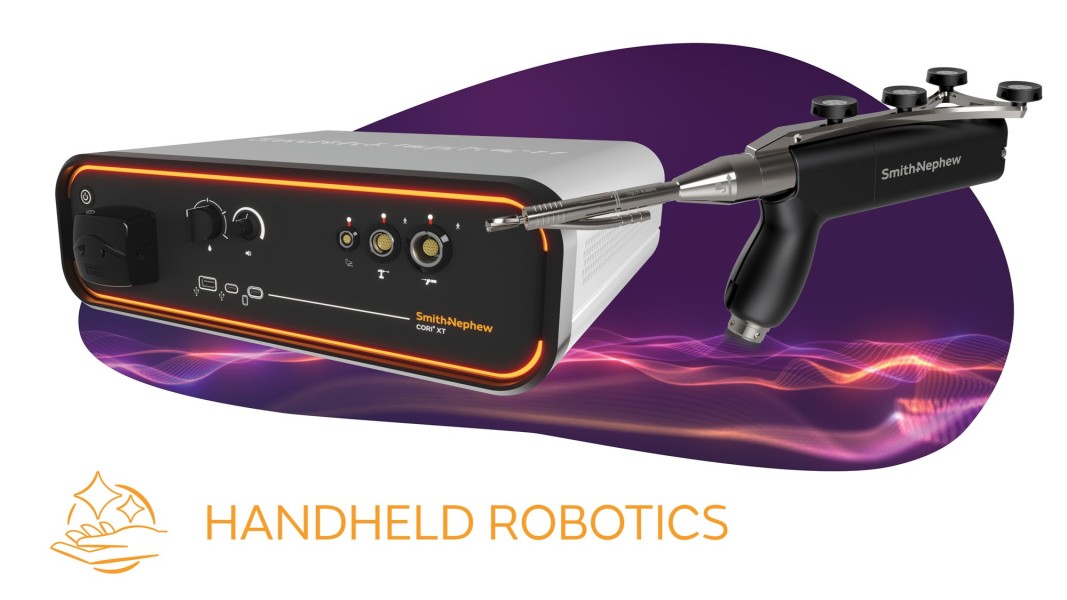
Smith+Nephew (LSE: SN, NYSE: SNN), the global medical technology company, announces the completion of the first clinical cases performed using the next‑generation CORI◊ XT Handheld Robotics Platform, marking an important milestone in the clinical introduction of its latest handheld robotics technology.

CORI XT Handheld Robotic Platform is designed to be the single handheld robotics platform for all orthopaedic needs - partial to revision knee, hip*, and anatomic and reverse shoulders - with a footprint tailored to the unique needs of hospitals and ambulatory surgical suites settings. These early cases represent the first use of CORI XT Platform across both knee and shoulder arthroplasty and reflect Smith+Nephew’s Skill Amplified approach to handheld robotics—designing technology to support and enhance surgeon expertise while preserving surgeon control, clinical judgment, and efficient workflows.
First robotic shoulder arthroplasty cases globally in hospital and ASC settings
The first shoulder arthroplasty cases using CORI XT Platform were performed at Duke Health by a surgical team led by Dr. Christopher Klifto. Dr. Klifto utilized CORI◊ SHOULDER Handheld Robotic Arthroplasty in combination with the AETOS◊ Shoulder System. CORI SHOULDER offers a complete robotic procedure, supporting handheld robotic execution of the humerus and glenoid, across both anatomic and reverse procedures.
Dr. Klifto said, “The CORI SHOULDER workflow was streamlined and efficient; registration and planning were seamless; and the post‑op x‑rays matched our pre‑op planning. A proud moment for the team and an exciting milestone for shoulder robotics.”
Building on this initial clinical experience, Dr. Bertrand Kaper completed the first CORI XT shoulder arthroplasty cases in an ambulatory surgery center (ASC) setting at North Valley Surgery Center in Scottsdale, Arizona, further expanding the use of CORI XT Platform across care environments, and highlighting the versatility and fit of the CORI XT Platform in an ASC setting, and the well-suited nature of handheld robotics to shoulder arthroplasty.
Reflecting on these first cases, Dr. Kaper said, “It is a privilege to be part of this transformative effort to bring the accuracy of robotic technology to the surgical treatment of shoulder arthritis. The use of CORI Handheld Robotics allows us to merge advanced technology with surgical expertise to deliver personalized care for shoulder surgery. As we have witnessed with our knee replacement patients, robotic technology enhances the potential for patient recovery and implant longevity. I am confident that these innovations will become the standard for helping our patients who are dealing with the pain and disability of shoulder arthritis.”
To learn more, please visit our CORI SHOULDER website.
First knee replacement cases with CORI XT Platform at NYU Langone
The first knee replacement procedures performed using the CORI XT Handheld Robotics Platform were completed at NYU Langone Health by Dr. Ran Schwarzkopf, orthopedic surgeon and joint replacement specialist. These cases mark the first clinical use of CORI XT Platform in knee arthroplasty and an important milestone in the platform’s broader rollout as its applications continue to expand.
Handheld robotics designed for accuracy1 without compromising efficiency
CORI XT Platform is designed to provide the benefits of robotic assistance while preserving the efficiency and familiarity of established surgical workflows. Its handheld form factor enables surgeons to access robotic guidance and execution support without disrupting procedural flow or adding operational complexity to the operating room.
As part of Smith+Nephew’s Skill Amplified robotics approach, CORI XT Platform is designed to enhance accuracy1 while maintaining surgeon control, tactile feedback, and decision‑making throughout the procedure. By integrating naturally into how surgeons already operate, the platform supports consistent execution without requiring changes to operating room setup or procedural workflow.
With its compact footprint and mobility, CORI XT Platform is suited for use across both hospital and ambulatory surgery center environments.2 The system integrates with Smith+Nephew’s CORIOGRAPH◊ Pre-Operative Planning and Modeling Services to support patient‑specific planning while enabling efficient intraoperative execution.
“These first clinical cases reflect close collaboration with surgeon partners and our commitment to introducing handheld robotics in a thoughtful and practical way,” said Mayank Shandil, Smith+Nephew Senior Vice President, Global Marketing Orthopaedics and Robotics. “Our Skill Amplified approach focuses on supporting surgical accuracy while enabling surgeons to work efficiently and confidently within their preferred workflows.”
The CORI XT Platform is part of Smith+Nephew’s broader MTECH (Musculoskeletal Technologies to Enhance Care and Healing) portfolio, spanning robotics, navigation, visualization, and enabling technologies across orthopaedic surgery.
About Smith+Nephew
Smith+Nephew is a portfolio medical technology business focused on the repair, regeneration and replacement of soft and hard tissue. We exist to restore people’s bodies and their self-belief by using technology to take the limits off living. We call this purpose ‘Life Unlimited’. Our 17,000 employees deliver this mission every day, making a difference to patients’ lives through the excellence of our product portfolio, and the invention and application of new technologies across our three global business units of Orthopaedics, Sports Medicine & ENT and Advanced Wound Management.
Founded in Hull, UK, in 1856, we now operate in around 100 countries, and generated annual sales of $6.2 billion in 2025. Smith+Nephew is a constituent of the FTSE100 (LSE:SN, NYSE:SNN). The terms ‘Group’ and ‘Smith+Nephew’ are used to refer to Smith & Nephew plc and its consolidated subsidiaries, unless the context requires otherwise.