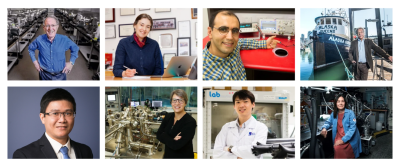

From left to right, upper row: Prof. Jeffrey I. Gordon (Washington University School of Medicine in St. Louis), Prof. Dame Clare P. Grey (University of Cambridge), Prof. Omid Kavehei (University of Sydney), and Prof. Daniel Pauly (University of British Columbia); lower row: Assoc. Prof. Hoang-Phuong Phan (UNSW Sydney), Prof. Michelle Simmons (Silicon Quantum Computing), Prof. Benjamin C. K. Tee (National University of Singapore), and Prof. Evelyn N. Wang (MIT).
Prof. Jeffrey I. Gordon: Opening the Door to the "Microbial Universe" Within the Human Body
Speaking at the "Science for Life" Symposium on "AI and Digital Transformation of Healthcare" on the morning of December 8, 2026, Prof. Jeffrey I. Gordon (Washington University School of Medicine in St. Louis, USA) will share fundamental insights into the human microbiome.
Widely recognized as a pioneer in microbiome science, he has unraveled the complex relationships between the gut microbiome and human health, development, and disease.
Beyond his remarkable scientific legacy, Prof. Gordon is a dedicated mentor who has trained more than 150 outstanding PhD students and postdoctoral fellows. His distinguished career has been recognized with numerous prestigious awards, including the Royal Society's Copley Medal (2018), the Balzan Prize (2021), and the Princess of Asturias Award for Technical and Scientific Research (2023), as well as membership in leading US academies of science and medicine.
Prof. Dame Clare P. Grey: Powering the Next-Generation Battery Revolution
On the afternoon of December 8, 2026, Dame Clare P. Grey (University of Cambridge, UK) will speak at Hanoi University of Science and Technology as part of the 2026 VinFuture Discovery Talk series, sharing in-depth insights into energy storage technologies.
She has pioneered the use of nuclear magnetic resonance (NMR) to elucidate structure-function relationships in materials for batteries, supercapacitors, and fuel cells. Extending her contributions beyond academic research, she actively translates scientific knowledge into practical applications as the co-founder of Nyobolt, a company specializing in ultra-fast-charging batteries, and Illumion, which develops optical instrumentation to study the mechanisms underlying battery operation.
Her distinguished career has been recognized with the Körber European Science Prize (2021), her appointment as Dame Commander of the Order of the British Empire (DBE, 2022), and her election as an International Member of the US National Academy of Sciences (2024).
Prof. Omid Kavehei: Bringing Human Intelligence to Tiny Microchips
Prof. Omid Kavehei, Deputy Head of the School of Biomedical Engineering at the University of Sydney, will explore intelligent microsystems, from brain-computer interfaces to on-chip quantum sensing, at "Inspirational Talks: The Next Breakthrough" on the afternoon of December 7, 2026.
His research focuses on integrating sensors, signal processing algorithms, and artificial intelligence applications onto a single microchip with ultra-low power consumption. He contributed to Australia's national Bionic Eye project and co-founded technology companies including BrainConnect and DeteQt. His innovations open up promising possibilities for intelligent implantable medical devices, wireless neural interfaces, and quantum sensing for magnetic field measurements, with potential applications in healthcare.
Prof. Daniel Pauly: Bringing the Ocean's Secrets to Light
At this year's VinFuture Sci-Tech Week, Prof. Daniel Pauly (University of British Columbia, Canada) will not only share in-depth insights into marine ecosystem management but also take part in an inspirational dialogue with students at Vietnam Maritime University on December 3, 2026.
He is the founder of the global research project Sea Around Us, co-founder of FishBase, an online encyclopedia covering more than 35,000 fish species, and a contributor to the development of Ecopath, widely used ecosystem modeling software.
With an extensive body of more than 1,000 scientific publications, Prof. Pauly has received numerous prestigious distinctions, including the Volvo Environment Prize (2006), the Albert Ier Grand Medal in Science (2016), and the BBVA Foundation Frontiers of Knowledge Award (2019). In 2017, he was named a Chevalier de la Légion d'Honneur by the French Government.
Assoc. Prof. Hoang-Phuong Phan: Developing Next-Generation Sensors to Pave the Way for Smart Healthcare
Assoc. Prof. Hoang-Phuong Phan is currently a Scientia Associate Professor and leads the Intelligent Microsystem Laboratory at UNSW Sydney, Australia. He will present his research on next-generation sensing technologies at "Inspirational Talks: The Next Breakthrough" on the morning of December 7, 2026.
Drawing on an interdisciplinary approach that brings together engineering, medicine, and materials science, his research focuses on developing wearable microsensors that capture heart sounds and other biological signals, implantable devices for health monitoring, and systems that support research into human tissues. Having undertaken postdoctoral research at Stanford University and Northwestern University, he has authored more than 170 scientific papers and holds four patents.
Prof. Michelle Simmons: Pioneering Chip Manufacturing with Atomic Precision
Having devoted more than 25 years to the field of atomic electronics, Prof. Michelle Simmons stands among the world's foremost pioneers advancing quantum computing technology. She will share her breakthroughs in manufacturing silicon devices with atomic precision at "Inspirational Talks: The Next Breakthrough" on the afternoon of December 7, 2026.
As CEO of Silicon Quantum Computing (SQC) and Director of the Centre of Excellence for Quantum Computation and Communication Technology (CQC²T) in Australia, she has led her team to historic achievements, including the creation of the world's smallest transistor and the world's first integrated circuit built with atomic precision, enabling individual phosphorus atoms to be positioned in silicon with an accuracy of 0.13 nanometers.
Her outstanding contributions have earned her numerous international awards and distinctions, notably the Feynman Prize in Nanotechnology, recognition as the L'ORÉAL-UNESCO Asia-Pacific Laureate in Physical Sciences (2017), the title of Australian of the Year (2018), and the Australian Prime Minister's Prize for Science (2023).
Prof. Benjamin C. K. Tee: Bringing the Human Sense of Touch to the World of Machines
At "Inspirational Talks: The Next Breakthrough" on the afternoon of December 7, 2026, Prof. Benjamin C. K. Tee, Professor of Materials Science and Engineering at the National University of Singapore (NUS), will share recent advances in self-healing electronic skins, opening up new possibilities for machines to sense and interact with the physical world.
His research has been distinguished by the development of soft, stretchable electronic materials incorporating sensors that mimic the human sense of touch. These innovations have given rise to a range of pioneering applications, including tactile sensors for robots and prosthetic hands, smart patches for wound monitoring, and self-healing robotic fibers.
Recognized as a World Economic Forum Young Scientist (2019) and named an MIT Technology Review Innovator Under 35 (Global, 2015), Prof. Tee has also distinguished himself as a technology entrepreneur, co-founding several healthcare startups and raising more than US$20 million in funding.
Prof. Evelyn N. Wang: A Quest for Solutions to Three of Humanity's Most Vital Challenges
Currently serving as MIT's Vice President for Energy and Climate and formerly Director of the US Advanced Research Projects Agency–Energy (ARPA-E), Prof. Evelyn N. Wang is a leading scientist in the search for solutions to the global resource crisis. She will speak at "Inspirational Talks: The Next Breakthrough" on the morning of December 7, 2026, on the topic "Breaking Boundaries: Transforming Energy, Water, and Food Systems."
Her pioneering achievements include solar thermophotovoltaic technologies, named among MIT Technology Review's 10 Breakthrough Technologies of 2017, and a device for extracting fresh water from air in arid environments, recognized by Scientific American. Her unwavering dedication and interdisciplinary vision have earned her membership in the National Academy of Engineering (2025) and election as a Fellow of the American Academy of Arts and Sciences (2023).
Through dialogues and inspirational talks featuring the world's leading scientists, VinFuture not only disseminates cutting-edge scientific knowledge but also creates opportunities for meaningful connections and fosters interdisciplinary research collaboration across nations. These activities reaffirm VinFuture's mission to connect global scientific minds and advance the translation of scientific breakthroughs into practical solutions that address humanity's challenges.
Hashtag: #VinFuture
 https://vinfutureprize.org/
The issuer is solely responsible for the content of this announcement.