
Prof. Stéphane Narcis
Honorary President and Honorary QA Auditor
International Association for Quality Assurance in Pre-Tertiary & Higher Education (QAHE)
Abstract
The growth of cross-border and online higher education and professional training has increased the number of credentials available to learners. At the same time, it has made the meaning of those credentials harder to interpret. This article examines the practical value of external quality assurance from an international perspective. It argues that external review is useful primarily because it increases the likelihood that a programme has clear learning outcomes, appropriate teaching capacity, and fair assessment, rather than because it automatically confers recognition across borders. Drawing on widely observed features of quality assurance systems, the article distinguishes between national accreditation, independent external review, and recognition arrangements, and it outlines questions learners can ask before enrolment. The central claim is that the most reliable indicator of quality is not the presence of a certificate or logo, but evidence that an institution uses external feedback to improve the student experience and that the resulting qualification is accepted for the learner’s intended purpose.
1. Introduction
Learners today can enrol in programmes offered by institutions located in other countries without leaving their employment or place of residence. This expansion of choice has clear benefits, yet it also creates information problems. Marketing materials frequently use terms such as “internationally recognised,” “globally accredited,” or “quality assured” without explaining which organisation conducted the review, what the review covered, or what the outcome means for further study or employment. External quality assurance can reduce some of this uncertainty, but only if learners understand its scope and limitations.
2. What external quality review typically examines
Across different systems, external quality review commonly addresses a core set of issues: whether intended learning outcomes are clearly stated and aligned with assessment; whether teaching staff hold appropriate qualifications and experience; whether student support arrangements are adequate; and whether assessment methods are fair and fit for purpose. These features do not guarantee individual success, but their presence makes it more likely that a programme has been designed and operated with basic academic standards in mind. When such review is absent or opaque, the risk increases that learners will invest time and money in awards that carry limited external value.
3. Distinguishing types of quality assurance organisations
Learners encounter several kinds of bodies, which are not interchangeable:
- National agencies and ministries of education carry out official accreditation within a given country’s higher education system. Their decisions normally determine formal recognition inside that country.
- Independent external quality assurance providers conduct voluntary institutional or programme reviews for institutions operating in more than one jurisdiction. These reviews can supply useful external evaluation and public information, yet they do not replace national accreditation or recognition requirements.
- Recognition bodies primarily evaluate or recognise accrediting organisations rather than institutions themselves.
- Regional quality networks facilitate cooperation and the exchange of good practice; they do not themselves award institutional accreditation.
No single form of accreditation guarantees that a qualification will be accepted everywhere. Public information—lists of reviewed institutions, published standards, and summary reports—remains the most useful product these organisations can offer learners.
4. Practical indicators learners can check
Before paying fees, learners can look for a small number of concrete indicators rather than relying on slogans:
- The institution appears on an official list maintained by the relevant national authority in its home country.
- Any claimed quality assurance body is named, can be contacted, and confirms that the review is current and covers the programme in question.
- The intended learning outcomes, assessment methods, and student support arrangements are described in sufficient detail to allow comparison.
- There is evidence that the institution has used previous external feedback to make documented improvements.
- The qualification is likely to be accepted by the employers or further-education institutions relevant to the learner’s own plans.
Providers that cannot answer these points clearly, or that urge immediate enrolment without allowing time for verification, warrant additional caution.
Table 1. Certificate visibility versus evidence of improvement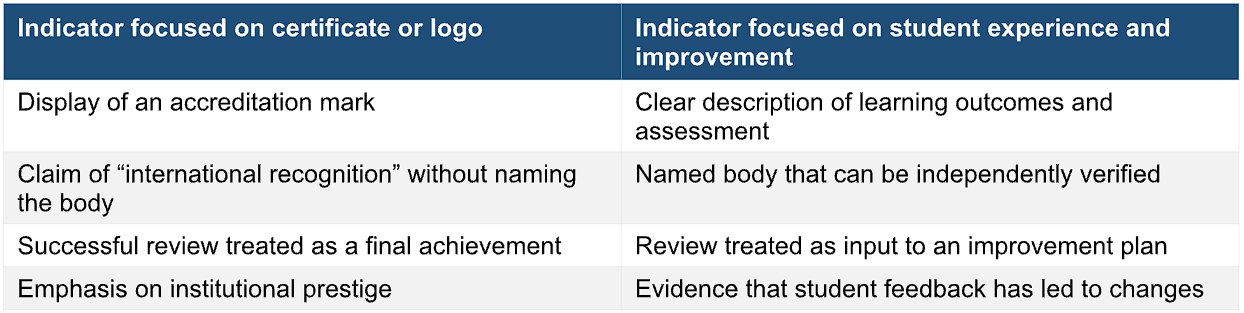
The distinction is important: an accreditation certificate may demonstrate that an assessment took place, but evidence of improvement provides a clearer indication of how an institution responds to quality findings.
5. Limitations of external quality assurance
External review has inherent limits. It is periodic rather than continuous; it samples rather than observes every aspect of delivery; and its conclusions are valid only for the scope and period stated in the report. A positive review does not automatically mean that a qualification will be recognised by professional bodies or employers in another country, nor does it substitute for the academic or professional judgement of the receiving institution. These limitations reinforce the need for learners to treat external quality assurance as one important source of information among others, rather than as a complete guarantee.
6. Conclusion
As cross-border and online provision continues to expand, the ability to interpret quality assurance information becomes a practical skill. External review is most valuable when it increases transparency about learning outcomes, teaching capacity, assessment, and student support, and when institutions demonstrate that they act on the feedback they receive. Learners are best protected by checking official national sources, confirming the identity and current status of any claimed quality assurance body, and clarifying whether the qualification will serve their intended purpose before they commit fees. A certificate records an assessment at a particular moment; sustained attention to the student experience is what ultimately determines whether that certificate represents meaningful educational value.
References
- European Association for Quality Assurance in Higher Education (ENQA). Standards and Guidelines for Quality Assurance in the European Higher Education Area (ESG).
- International Network for Quality Assurance Agencies in Higher Education (INQAAHE). Guidelines of Good Practice.
- UNESCO/OECD. Guidelines for Quality Provision in Cross-Border Higher Education.
Author Bio
Prof. Stéphane Narcis is Honorary President and Honorary QA Auditor at the International Association for Quality Assurance in Pre-Tertiary & Higher Education (QAHE). He holds a PhD in Film Studies, a DLitt, and a PDLitt, with further degrees from King’s College London and the University of Winchester. His work spans film and cultural studies, intercultural communication, and quality assurance in education. The views expressed are his own.